| Professor PhD (Comp. Sc.), MSc, BMusic, BA (Queen's University, Canada) Director, Document and Pattern Recognition Lab (dprl) Department of Computer Science Rochester Institute of Technology (NY, USA) RIT Academic Calendar |
Research
I direct the Document and Pattern Recognition Laboratory (dprl) in the Department of Computer Science. I work on problems that involve pattern recognition, machine learning, information retrieval, and human-computer interaction. Before joining RIT, I worked in the Centre for Pattern Recognition and Machine Intelligence, the Diagram Recognition and Medical Computing labs at Queen's University (Canada), Legasys Corporation (a legacy software solution company), and at the Xerox Research Center Webster.
Over the years I have worked on a number of problems, often with the help of great students and staff from the dprl. These include computer-assisted surgical planning, CAPTCHAs, parsing of two-dimensional notations, document analysis and recognition for typeset and handwritten documents, detecting text in natural scenes, evaluation metrics and tools for structural pattern recognition, and information retrieval in documents and videos. Currently the dprl is focusing on work for the MathSeer project, and the MMLI project (chemical informatics).
About doing research...
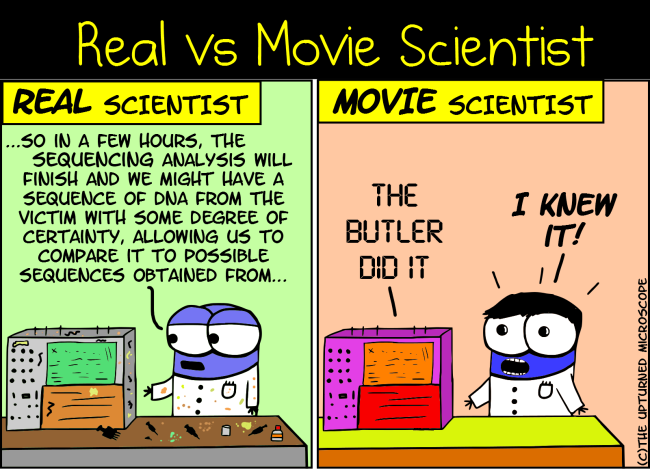
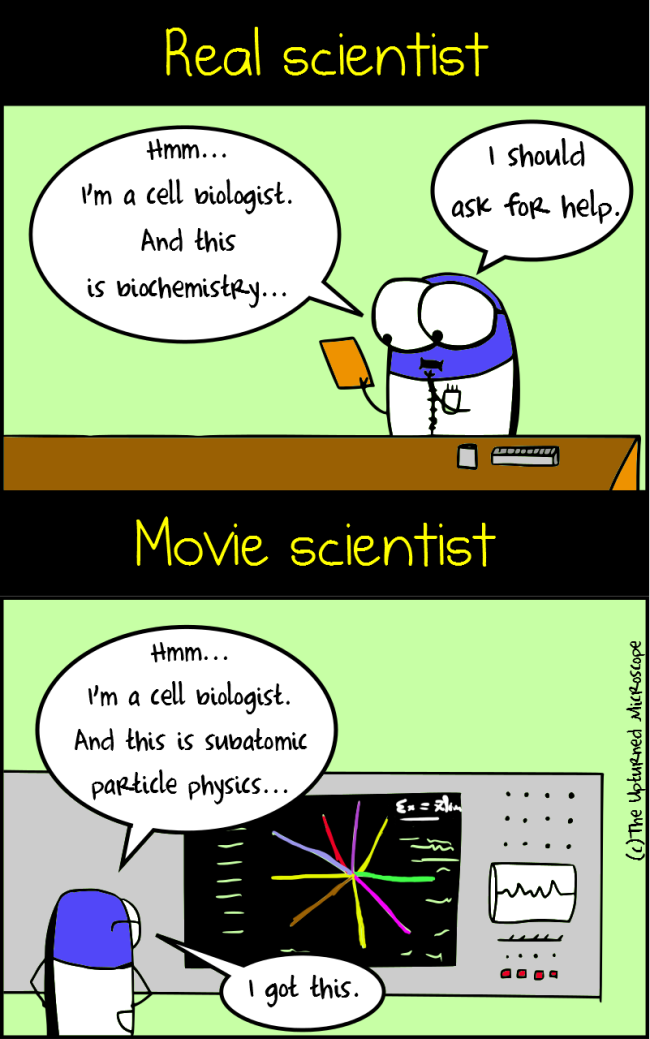
(R. Zanibbi, Oct. 2014, Edited Aug. 2016)The cartoons below represent common misconceptions about science and research succinctly. While I genuinely enjoy doing research, I have to remind myself often that good research is a slow and difficult business. Acknowledging the limitations of both your work and yourself is critical, as well as learning to appreciate continual learning and the process of doing research. Writing up and presenting results is relatively quick, usually. Obtaining meaningful results for hard problems can require years of work, and even if one manages to obtain them, the results seldom, if ever, flow from an 'elegant, correct and complete' model that one hopes for when starting a project. If despite all these challenges, one finds they are repeatedly interested in starting new research projects, then they are a researcher.
On a personal note, I 'left' music at the end of my undergraduate studies to do graduate studies in Computer Science. This was to be a simpler and saner way to live, I thought. I then discovered that the day-to-day activities of a researcher and musician/composer are basically the same, with irregular work schedules and locations, meeting and collaborating with people from diverse backgrounds, sometimes working extremely hard for very long hours, performing (aka 'giving a talk' or 'writing a paper'), travel, finding ways to both be and remain creative, and lots and lots and lots of improvisation and hustling.
It seems to me that leading a research lab is a lot like leading a jazz ensemble. You have a fluid stream of people joining and leaving the group, each with different skills and interests. You 'perform' with this group regularly, despite changing personnel (i.e., carry out experiments and other research tasks). A good jazz group tries to push the music, exploring possibilities to produce enjoyable and interesting sounds. The challenge of the leader in such a group is to maintain enough structure and discipline without squashing good ideas and directions from band members during performances. This involves risk, inevitably leading to errors, and some performances fail. Without a proper balance between form and instinct things are boring, or messy. It took awhile for me to understand and accept this, but once I did, I found that I was frustrated far less often. I reasoned that if research is a creative process, then the process will often be unpredictable, and that this uncertainty may be necessary to produce interesting work.
Many of the best ideas and directions for research I've come across were due to classes that I've taught. Teaching and research when done well are complementary, intertwined even. Until you can explain your work briefly and make clear where the remaining holes are, you probably have not reached the limits of your ability to understand your work.
At its best, I think that research involves creating helpful knowledge and tools to share with others. These helpful tools include well designed and documented prototypes, and informative, well-written research papers. Whether or not I ever 'truly' create these with my students and collaborators, they remain the primary goals for my work. I would rather fail trying to do this than stop.