Computer Graphics I - online

4003-570-02 / 4005-761-02

 (Winter 2012-2013)


Instructor: Joe Geigel
Office: 70-3527
Office Hours: please arrange on line meetings via e-mail.
E-mail: jmg@cs.rit.edu
URL: http://www.cs.rit.edu/~jmg/
Course URL: http://www.cs.rit.edu/~jmg/cgI-ol

PREREQUISITE
:  Third Year Standing or permission of instructor


Description

Computer Graphics I is a study of the hardware and software principles of interactive raster graphics. Topics include an introduction to the basic concepts, 2-D and 3-D modeling and transformations, viewing transformations, projections, rendering techniques, graphical software packages and graphics systems. Students will use computer graphics packages and implement fundamental computer graphics algorithms.

Learning Outcomes

After completion of this course:

Texts

There are no required texts.   Much of the material in the class, however, is covered in the following optional book.  (Chapters corresponding to weekly lectures will be indicated on the SCHEDULE page.)   That said, assignments and exercises will not be taken from this text.

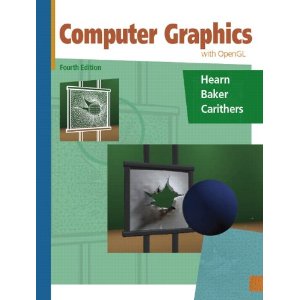
Textbook image Donald Hearn, M. Pauline Baker, and Warren Carithers,  Computer Graphics with OpenGL (4th Edition)Prentice-Hall, 2010, ISBN: 0136053580

In addition, the following, are  good references on OpenGL:

OpenGL Red book image OpenGL Bible
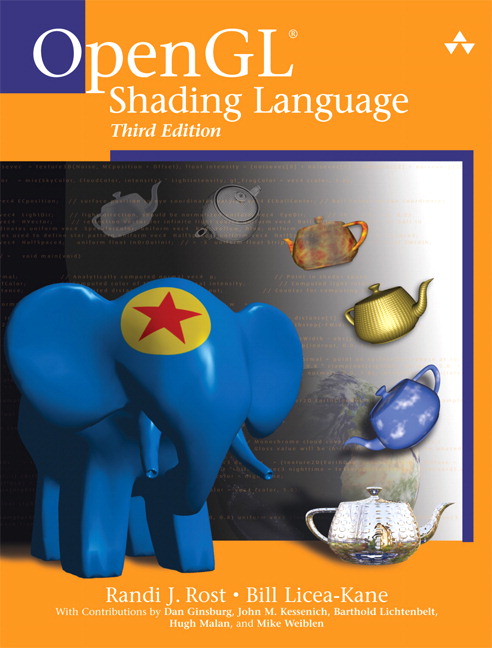
OpeGL Shading Language by Rost, et. al.
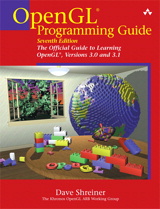
Dave Shreiner and The Khronos OpenGL ARB Group, OpenGL Programming Guide: The Official Guide to Learning OpenGL, Versions 3.0 and 3.1, 7th Edition, Addison-Wesely, 2009, ISBN: 0-321-55262-8

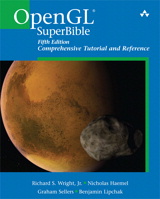
 Richard S. Wright, Jr.,  Benjamin Lipchak,  Nicholas Haemel, Graham Sellers, OpenGL® SuperBible: Comprehensive Tutorial and Reference, 5th Edition, Addison-Wesley, 2010, ISBN: 0-321-71261-7

Randy Rost, Bill Licea-Kane, Dan Ginsburg, John Kissenich, Barthold Lichtenbelt, Hugh Malan, Mike Weiblen,. OpenGL Shading Language, 3rd Edition, Addison Wesley, 2009, ISBN: 978-0321637635

Schedule

Each week will focus on a given specific topic and/or set of algorithms.  The list of topics to be discussed each week can be found in the SCHEDULE section of this Web page along with sections in the optional text above where that topic is discussed.  Note that not all topics are covered in the optional text and that supplemental notes will be provided as needed and posted in the CONTENT area of mycourses.  Also on the SCHEDULE is a list of due dates for assignments and exams.

Weekly Activities

A typical week in the class will consist of three activities:
  1. Online Activity and Discussion -  This activity will involve interaction with an application or online applet and is designed to introduce you to the topic for the week.   The activity will be posted in the DISCUSSION area of mycourses and will involve partipation in on-line converstation about the activity and the topic (once the activity has been completed).   Except for Week 1, each activity will be posted at the end (Friday) of the previous week.   Initial posts on the discussion board about the activity are expected before the posting of the lecture (see below) on Wednesday.   Each week's discussion topic will remain active for the remainder of the week for further discussion.
  1. Lecture - Links to one or two short (approx 10-15 minutes) video lectures will be posted.   These lectures will explain the week's topic in more detail and prepare you for the third activity (which will be a programming assignment).    Links to the lecture videos will be posted in the CONTENT area of mycourses on Wednesdays.   It is expected that student complete the online activity prior to viewing the lecture videos.  An additional  DISCUSSION topic will be set up weekly to discuss any questions or issues that arise from the lectures.
  1. Programming Assignment - To apply your understanding of the weekly topic, you will be asked to put the info in the lecture to practice via by coding one or more of the algorithms presented in the lectures.   These assignments are designed to build upon one another and will prepare you in completing your midterm and final exam (described below).   Assignments will be posted in the CONTENT area (on Wednesday evenings) with completed assignments to be submitted via the mycourses DROPBOXes.  Typically, students will have 1 week to complete these assignments (Assignments will generally be due on Wednesdays).

Exams

The exams for this course will be given as programming projects.   It is expected that the code created for the weeky programming assignments be reused and incorporated into the code for the exams.  There will be a midterm and a final:
The requirements for both exams will be posted in the CONTENT area of mycourses as the quarter progresses.

Survey Paper (for Graudate Students Only)

For students taking the course for graudate credit, a survey paper that explores one aspect of Computer Graphics will be required.   In creating this paper, the student should identify at least five recent (within the last 10 years) papers related to a topic and summarize, compare, and discuss the work in these papers.   It is intended that the student choose a topic close to their Graduate capstone project/thesis or if they haven't yet started their capstone, a potential topic that might turn into a capstone project.

Deliverables for this paper includes:
Due dates for each of the deliverables can be found in the SCHEDULE.

Grading

Points 0 1 2
Criteria Awarded to those who did not paricipate or whose postings do not contribute or demonstrate any relevance to the weekly topic or assignment. Postings may not indicate an understanding of the weekly topic or assigment or does not contribute to the discussion in any particular way. Must post at least one message that demonstrates understanding of the weekly topic or assignment and adds to the discussion in an orginal and meaningful way.
Bonus points will be given for discussions that are particularly active.   That said, the total number of points that will be counted for onlibe activities over the whole year will not exceed 100.

The final grade will be determined using the following weights for each of the categories:


Graduate  Undergraduate
Online Activities / Discussions  30% 35%
Weekly Programming Assignments 30% 35%
"Exams" 25% 30%
Grad Report
15%

Policy on Late Submissions

It is extremely important to continue to make progress as the course progresses.  As such, late deliverables will be not be allowed. If you forsee any problems with meeting deliverable deadlines, please contact the instructor well in advance of the deadline that might be missed we can attempt to work out alternate arrangements.    Late submissions without  prior permission or notification will be heavy penalized.

Policy on Academic Dishonesty

Please be aware of the Computer Science Policy on Academic Dishonesty as well the RIT Policy on Academic Dishonesty found by following the links.  

Any form of academic dishonesty will not be tolerated.  
Consequences of any discovered academic dishonesty incidents will be applied as specified in these policies. 


last updated 11/15/12